Anthropology doesn't teach you facts about a culture. It teaches you to see networks of interactions: all of the invisible structure underneath a wedding, a market, a funeral, that you might miss if you aren't really looking. You learn to dig into the logic that explains why it takes this shape and not another.
Strategy asks for the same skillset. A strategist sees the schema a brand finds itself in: its situation, its competitive set, what the audience believes and doesn't believe, does and doesn't do, the history that brought everyone to this room, the culture surrounding all of it. Mostly this is learned through practice. Really, advertising and the strategy discipline themselves are cultures to look at through the anthropological lens. They each have shared language, cultural markers, rituals, and quirks.
Something I realized pretty early on while studying anthropology, before I realized it explained a lot about the way I thought in general, was that the field had such a rich, connected web of concepts. Each concept (kinship, gift-giving/reciprocity, rituals and ceremonies, and so on) opened my mind to seeing and wondering what else was connected to it, and what else I wasn't seeing. That's always been how my brain worked. I need to break down the gigantic concept, like Big “C” Culture, into its smaller and smaller parts, until I could see the entire structure.
Ever since I made my way into marketing and advertising, I've looked for ways to bring the social sciences, especially anthropology and human geography, into my briefs and the way I frame problems. I realized I really wanted something that could help make it a little easier to break a problem down into its parts and find the topic, concept, or theory that could contextualize it and open a new way of thinking.
And that's the origin of Everyday Theory. It's a tool built on the belief that seeing the schema is the job, and there should be an easier way to borrow from the schemas that academia has been building, editing, and reframing for centuries.
The Difference Between Being Right and Finding the System
Every strategist has had the moment. You land on an insight. It feels right. Then months or years later, you find a paper describing the exact mechanism you named on instinct. Sometimes it's decades old.
It's a great feeling when a paper confirms you were right. Slightly annoying that you found it after the fact, but still a great feeling. You can see the system the finding lives inside: the contradictions other researchers raised, the conditions where the effect reverses, the adjacent theories that cover the parts your instinct might have missed. You get the architecture around it.
In undergrad, I wrote my senior thesis on African-American students and their relationship to the environment (you can find it here). I remember building annotated bibliographies. I remember finding a great article and seeing pages and pages of references I now had to hunt down to see where and how they interacted with what I'd just read.
Sometimes, for us strategists, the “why” lives in the references. In a century of research on how humans actually work: why people conform even when they know they're wrong (Solomon Asch, 1951)1, why loss hurts twice as much as an equivalent gain feels good (Kahneman and Tversky, 1979)2, why we tell stories to make sense of things that don't make sense (Jerome Bruner, 1986)3, why belonging to a group becomes part of how we understand ourselves (Tajfel and Turner, 1979)4.
A lot of this body of knowledge only shows up in fragments. A Kahneman reference in a keynote. A Cialdini chapter from a college class a decade ago. A social proof principle copied from a blog. We pick up tools without understanding the systems they come from, so we use them wrong, or half right, and we miss the connections between them completely. Some of the academy is genuinely hard to reach: paywalled, written in a way that doesn't survive contact with a brief. I wanted to build the entry point into that.
A brief grounded in Prospect Theory but ignorant of Social Identity Theory changes the price equation and leaves the belonging question untouched. A brief built on behavioral economics alone optimizes the decision and misses the meaning. The theories aren't interchangeable. They work in combination. The real strategic value is in the intersection.
Everyday Theory: The Tool
My first job was at a digital agency, and what I immediately noticed was a culture that valued “data” (read: numbers) way more than anything I would have brought from my social science background. So I adapted, learned what was valued, where, how, and why, and I became someone who could speak that language. But in March 2020, I found myself on mentor calls with Galla Barrett (Gretel) and Lindsay Wehking (Nonfiction Research). They both encouraged me to investigate how I could reframe what I wanted to bring in a more rigorous way. Maybe Everyday Theory is me still trying to follow through on that advice.
I wanted to connect what I learned from academia with what I was doing as a strategist. Not to make briefs more academic, but to make them more true, and honestly, to build my own unique strategy style.
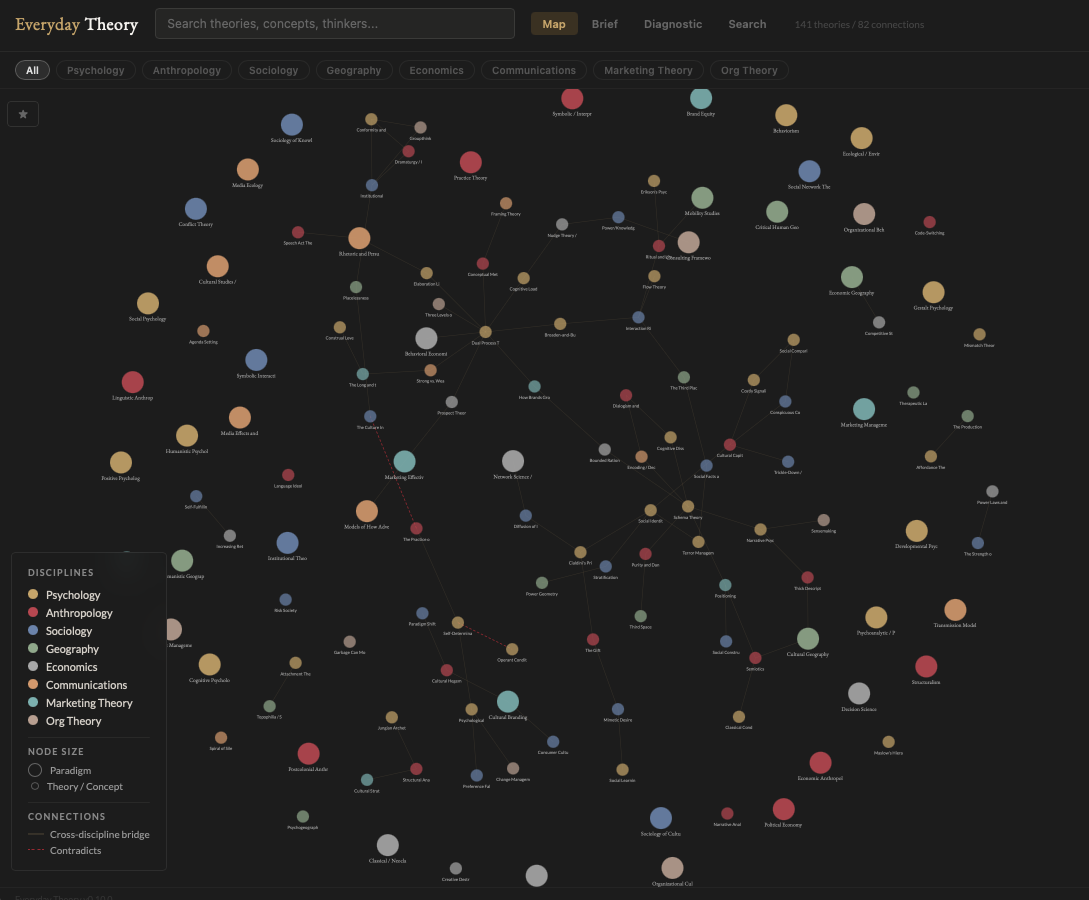
Everyday Theory is an interactive network mapping 141 theories across eight disciplines: psychology, anthropology, sociology, human geography, economics, communications, marketing theory, and organizational theory. Three levels of abstraction.
Paradigms at the top: the big worldviews of each discipline that shape how entire generations of thinkers approached human behavior.
Core theories in the middle: the workhorse ideas you'd actually cite in a strategy document.
Key concepts at the bottom: the sharpest, most citable findings that make a theory usable.
It's really a map of relationships. Theories connect by type: some extend, some contradict, some run parallel, some apply to another, some operationalize. That structure matters because human behavior isn't modular, or rational, or one-size-fits-all. A consumer refusing a free trial upgrade isn't explained by only one theory. It's Loss Aversion (Kahneman), Psychological Reactance (Brehm), Status Signaling (Zahavi), and Social Identity Theory (Tajfel), all at once. Which theory you reach for determines what strategy you build. Knowing how they relate to each other is what makes the strategy right for a particular problem framing.
I built an AI layer on top of the network. Paste a brief, describe a challenge, and the tool surfaces relevant theories, a flavor profile of the intellectual territory, and strategy starters. It doesn't replace the strategist's thinking. It grounds the brief in something more durable, and shows some places you could go.
Why It Matters
Academic papers are peer-reviewed. The findings are replicated, challenged, refined, sometimes overturned. What survives isn't perfect, but it's more rigorous than a trend deck. Ground a brief in Symbolic Interactionism, Terror Management Theory, or Costly Signaling, and you're building on top of a model that has held up across decades of scrutiny and cross-cultural testing.
This matters for three reasons.
First: it makes the strategy more defensible. “We believe this because Tajfel and Turner's Social Identity research4 demonstrates group belonging is constitutive of self-concept, not peripheral to it” is a different argument than “our research shows consumers feel a sense of community around the brand.” That's a deeper level of engagement with what's going on.
Second: it makes the creative better. The most memorable work doesn't come from the most compelling data point. It comes from the strategist identifying the human component beneath it, in a way the creative team understands and connects to. Not “people feel like they belong.” Better creative problem, better work.
Third: it widens what you can even see. A trend report hands you more of your category. A theory doesn't know what category it's in, so it can travel. A costly signaling insight built for a luxury brand applies cleanly to a B2B sales cycle. A social identity framework works whether the community forms around a sneaker or a hospital system. That's where the unexpected pairing lives: two categories with no obvious reason to sit next to each other that, once you see the mechanism, obviously do.
Theory isn't decoration on top of strategy. It's the reason the strategy works. Name it correctly, trace it to its source, understand it in relation to the theories around it, and that's the difference between a brief that produces competent creative and one that produces work no one can explain and no one can forget.
What This Looks Like in Practice
Most professors are Everyday Theorists. Mine was Dr. Feliciano-Santos. I took her ANTH 371 (Ethnography of Communication) and ANTH 352 (Magic and Religion) courses at UofSC. In ANTH 371 we had a project to record an interaction and unpack it as a linguistic anthropologist would. I remember handing in my transcript and what I thought was going on. Dr. Feliciano-Santos gave me a list of topics to look into, and one of them was nagging. I remember seeing the lightning bolt go through my brain. That was exactly what was happening, and I didn't have the word or theoretical concept to attach to it. Nagging took me to more articles and connected more and more topics. I felt like I was excavating a whole new way to look at how I communicated and interacted with other people.
Structurally, that's what I hope Everyday Theory does. It's not a search engine returning one relevant theory. It's a map showing you the theory you were reaching for, and everything it connects to, the same way Dr. Feliciano-Santos could see the shape of an idea in my writing before I had the words for it myself. Paste a brief, describe a challenge, and the tool surfaces a cluster: the paradigm you're operating in, the theories that extend it, the ones that contradict it, the adjacent concepts you didn't know were adjacent.
What emerges is a more precise problem. And a more precise problem is, nine times out of ten, the most valuable thing a strategist can give a creative team.
The Claim
The industry spends enormous energy chasing the zeitgeist. Finding the cultural moment. Naming the trend before the agency down the street does. Building a deck around whatever shifted on social media this quarter. That's useful, but it's built on sand that moves every few months, and every agency is standing on the same patch of sand at the same time.
The thing that gets missed is all of the stuff underneath. The underlying principles of human behavior and culture that have held since humans first had a concept of culture at all. The zeitgeist shifts, but the plates underneath it don't. They're not on the surface where the trend reports are looking; they sit below it, and they rarely change.
Everyday Theory is my attempt to get to what's underneath. Again, not to make strategy more academic, but to make it more honest. Bring the map into the room where the brief gets written, so that when culture shifts again next quarter, and it will, the strategy underneath the brief doesn't have to shift with it.
That's the brief that changes behavior.
Everyday Theory is a living map, 141 theories and counting.
Explore Everyday Theory →