Cold Open: Content Unavailable
I bought a movie. I didn't rent it. I bought it. A Man Called Otto on Amazon Prime Video. I got an email receipt.
When I tried to watch it outside of Amazon's ecosystem, I couldn't. There was no file. No disc. Nothing that belonged to me. Just an encrypted mess that frustrated me to no end. I made a purchase but what I got was a permission slip.
That was one moment. There were many others.
The "Leaving Netflix" notification. You're mid-scroll, looking for something to watch, and a small banner tells you the show you wanted is disappearing in 14 days. Maybe you don't even see the heads up until it's too late. The show isn't just gone. It's just going to someone else's streaming service so you can pay them more money every month.


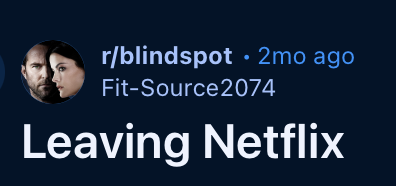

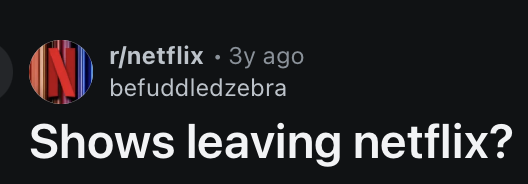
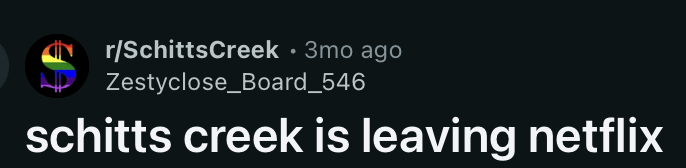
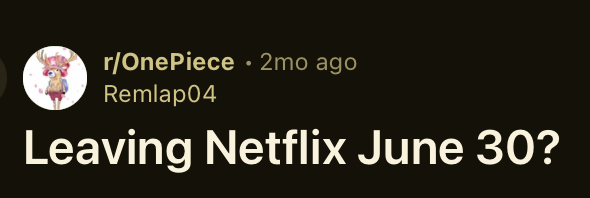

Reddit posts from r/television, r/cartoons, r/GilmoreGirls, r/howyoudoin, r/startrek, r/SchittsCreek, r/OnePiece, r/blindspot. These aren't tech communities. These are fans.
Then there was Mad Men bouncing between services. (I bought the series on Apple TV, but I also own it on DVD. Can you tell I have a problem?)
Then PlayStation announcing the end of physical game discs.
Then the ridiculous amount of money I spend a month in subscriptions for content I barely touched. But the budget wasn't the real problem. The budget was what I looked at after I realized I was fed up. The real problem was a feeling I didn't have language for yet. I was inside a system that had promised me access but was really anti-ownership.
The Pilot
Streaming had an enemy: friction.
Late fees. Due dates. Driving to Blockbuster to scan half-empty shelves. The rental model was punishing people for doing the thing it existed to let you do.
Netflix saw the fault line. People loved watching movies at home, but the late fee became the symbol of everything painful about that experience. So Netflix killed it. No late fees, no due dates. Unlimited rentals, flat monthly price, delivered to your door. They removed every point of friction between you and the thing you wanted to watch. Blockbuster was the villain. Netflix was the underdog.1
Hulu told a version of the same story. When it launched in 2008, it was free. F-R-E-E. Current-season TV, streaming instantly in your browser, no subscription required. Watch what you want, when you want, no paying for a cable bundle full of channels you'd never touch.2
The entire category was founded on a shared promise of more control, more choice, fewer restrictions. The enemy in this case was the cable bundle, the late fee, the physical constraint of shelves and discs and store hours.
For a while, the promise held. The category delivered exactly what it said it would.
That makes what happened next worse, not better.
Terms of Service: Content May Be Removed
The promise didn't break all at once; it eroded. When I look back, that erosion was truly death by a thousand cuts.
The average American household now spends $69 a month on streaming video alone, subscribing to roughly four platforms.3 Expand beyond video (music, cloud storage, productivity tools, gaming) and the average crosses $1,000 a year. Over five years, that's $5,000. The kicker is that you own nothing at the end of it.
Disney+ launched at $6.99. The ad-free tier now costs $18.99. That's a 171% increase.
Netflix, the company that killed late fees, charges up to $26.99 for its premium plan.
Hulu, the service that launched for free, costs $18.49 without ads.
The thing that promised to save you from the cable bundle now costs more than the cable bundle did.
Again, price is not the center of this story. Price is the symptom. Control is the true problem.
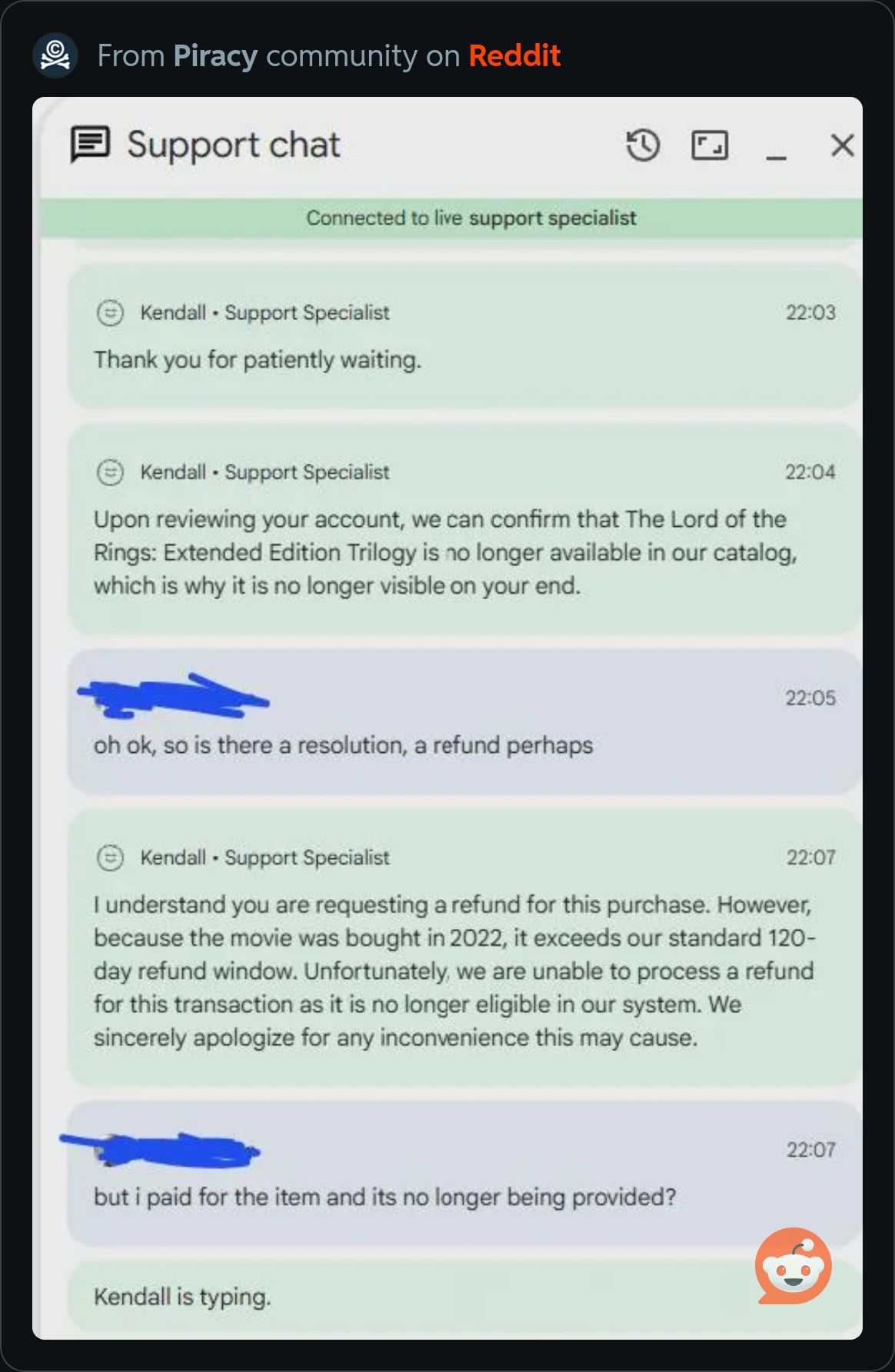
A Google customer bought the Lord of the Rings: Extended Edition Trilogy. Google removed it from their catalog. When the customer asked for a refund, they were told the 2022 purchase exceeded the 120-day refund window. The customer's last message: "but i paid for the item and its no longer being provided?" Source: r/degoogle
There's no answer for that question because this is how things work.
Amazon has been sued over the "Buy" button on Prime Video. They say using "buy" isn't deceptive because people get that "buy" just means "license."4
So "buy" doesn't mean buy. It means rent, indefinitely, until someone decides otherwise.
In early 2025, Amazon ended the ability to download Kindle books to your computer. Gamers filed a class-action lawsuit against Ubisoft after the publisher killed the servers for The Crew, a game people had purchased, making it permanently unplayable. A movement called Stop Killing Games emerged, demanding publishers create end-of-life plans so purchased games can survive.
On July 1, 2026, Sony announced that physical disc production for all new PlayStation games ends January 2028.5 Days before the announcement, fans discovered the "physical" edition of Grand Theft Auto VI would contain only a download code inside the box. Even the box is a lie now.
This isn't limited to video. On Spotify, you can build a library of thousands of songs, organize them into playlists that map the chapters of your life, and lose every single one if you cancel or a licensing deal expires. The music is yours to organize, not to keep.
The modern digital economy is something that looks like access and feels like ownership right up until it doesn't. The subscription model has rewritten what it means to "have" something, and it extends well beyond entertainment. Software. Cars. Farm equipment. Fitness devices. It's a perma-rental world now.
But media is where the betrayal cuts deepest. Media is personal. The show you rewatch when you're sick or can't sleep. The movie you bought for your kids. The album that got you through a bad year. When those disappear, it doesn't feel like a licensing change. It feels like something was taken from you.
Off-Platform: Going Local
Something is happening. Most people haven't noticed.
The subreddit r/selfhosted added 41,000 new members in 2020. In 2025, it added 218,000. It now has over 725,000 subscribers.6 The number of self-hosted software alternatives grew 45% between 2023 and 2026.7
YouTube is full of people documenting their homelab setups, building personal media servers, running their own cloud storage. These aren't all IT professionals. Many are regular people who got tired of the ownership lie and decided to build something better.
Jellyfin, the open-source media server, effectively won the media server category after Plex got increasingly aggressive with monetization. The incumbent tightened the screws. The users defected to something they controlled. Sound familiar?
The movement is even pulling non-technical people into tools that used to be developer-only. GitHub. Docker. Raspberry Pi. It's still a small group. But it's a group that's growing because the motivation got stronger, not because the tools got simpler.
Can you tell I'm one of these people???
My defection started with a DVD collection. For a long time, I'd had trouble getting fiber internet at my house, and that led me to build up my personal library of DVDs and Blu-rays. They sat on a shelf, mostly forgotten unless the Wi-Fi dropped. But when I looked at what I was actually paying for, and what I was actually getting, that collection started to look like real value to me.
I already had my own library that I owned. Just waiting for me to make real use of it.
I'm planning on buying a NAS (network-attached storage device) and setting up a media server.
This whole project wasn't driven by a technical itch. Just me realizing I already have the content, I just need the hardware to use it how I want.
In my digging into the NAS world, I've realized it's not just video. People are, and have been, doing the same thing with music.
U.S. vinyl revenue crossed $1 billion in 2025. Nineteenth consecutive year of growth. Unit sales up nearly 8%.8 CD sales surged 16% in the first half of 2026.9 The kicker is that approximately half of Gen Z and Millennial CD buyers don't own a CD player.
If it means nobody can revoke it, relocate it, or sunset it. That instinct is a signal that I don't think is going away. It's only getting louder.
Shelf Space
The NAS market is growing at a 17% compound annual rate.10 But nobody in this space is selling the feeling. Every brand is selling specs. Bay counts. Processor speeds. Gigabytes per second. The hardware is the product. The meaning is absent. Gigabit this, gigabit that.
The opportunity: someone is going to become the brand of digital self-determination. Right now, that brand doesn't exist in any meaningful consumer-facing way. I see three companies in a position to claim it, and they're each occupying a different niche.
UGREEN
UGREEN is the one to watch and my frontrunner. A consumer electronics brand with over 200 million global users, built on accessories and charging products people love. In late 2025, they put a NAS in 460 Walmart stores. No other NAS brand has made that distribution move. Their hardware is aggressively priced and has competitive specs designed for people who have never heard the word "NAS." At CES 2026, their AI-powered NAS line raised over $6.6 million on Kickstarter. UGREEN has the distribution, the price point, and the consumer instinct. They can own this tension and cultural pushback to sell the feeling of taking something back. They are the fresh, upstart that can rewrite the rules of the category.
Synology
Synology is the trusted incumbent. Best software in the category. Deep ecosystem. Loyal user base. But they're making a dangerous move: newer models now require Synology-branded or Synology-validated hard drives to enable full system features. They're tightening the ecosystem at the exact moment consumers are fleeing these tightened ecosystems. Synology risks becoming the thing their customers originally left. There's a version of Synology's future that looks like what happened to Plex. Or, for that matter, what happened to Netflix.
QNAP
QNAP is the power user's brand. More hardware per dollar, more expansion options, more raw flexibility. QNAP won't bring self-hosting to the mainstream, but they can own the serious end of the market and build loyalty with the people who influence everyone else.
The strategic argument is simple. The first NAS brand that stops selling storage and starts selling digital self-determination will own a position no competitor can take from them. Not because the hardware is better. Because the promise is exactly the frustration people relate to.
Storage Full
But, of course, there are other problems.
Hard drive prices are elevated because AI infrastructure and data center demand have pushed costs up. A proper NAS requires an upfront investment most people aren't used to making for something they previously got for a monthly fee. Then there's a learning curve. It's shorter than it used to be, but it's real. Self-hosting means taking responsibility for your own backups, your own maintenance, your own troubleshooting.
I'm not arguing everyone should cancel their subscriptions and build a server. That's not realistic, and pretending it is would undermine everything honest about this argument.
What I'm saying is: the trade-offs of the current system are real, they're getting worse, and for a growing number of people, the math is starting to favor doing it yourself. Even when doing it yourself is harder than pressing play.
Changing Channels
Zoom out and you see the same pattern repeating across categories.
In April 2026, John Deere settled a class-action lawsuit for $99 million over restricting farmers from repairing their own equipment.11 Right to repair has gone from niche advocacy to a political issue. The core question is the same: if you can't fix the thing you bought, do you own it?
Flip phone sales among 18-to-24-year-olds increased 148% between 2021 and 2024.12 There's a growing "Analog 2026" movement where basic phones are becoming a status symbol. Gen Z, the most digitally native generation in history, is voluntarily downgrading.
Vinyl has grown for 19 consecutive years. Cassettes have quadrupled over the past decade. Kodak doubled film production since 2022. CD buyers don't own CD players.
In gaming, Stop Killing Games demands that publishers let purchased games survive beyond server shutdowns. When you buy something, it should still exist after the company decides it's done supporting it.
None of these movements share a name or even a platform. A farmer in Nebraska fighting to fix his own tractor has no idea he has anything in common with a 22-year-old in Brooklyn buying a flip phone. (Or a 30-something in Atlanta building a media server from a DVD collection.)
But they're all doing the same thing. They followed a promise, watched it get quietly rewritten, and decided to rebuild the thing they were promised on their own terms.